


Surgeons from the Division of Colon and Rectal Surgery (Michael H. Froehlich, MD; Mark A. Heimberger, MD; Nicholas J. Ahn, MD; and Deborah A. Nagle, MD) of Stony Brook Medicine's Department of Surgery, have had one of their didactic procedural videos published by Diseases of the Colon & Rectum (Diseases of the Colon & Rectum 69(4):p 670-671, April 2026), considered a leading international journal for colorectal surgery (ranked in the top 10 percent of all peer-reviewed surgery journals). The video, titled "Robotic-Assisted Natural-Orifice Intracorporeal Anastomosis and Transrectal Extraction Procedure for Cancer: A Modified Approach With a Side-to-End Anastomosis and Stapled Colotomy Closure," is available on the journal's YouTube channel (please note: Video shows a surgical procedure and contains graphic images that may not be suitable for all viewers).
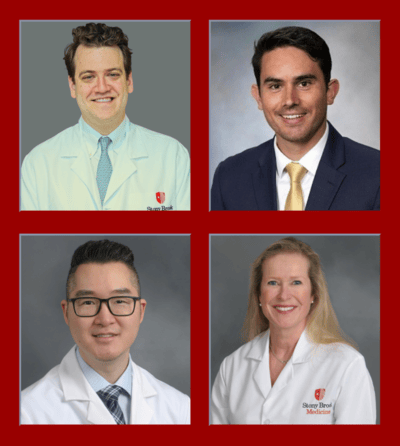
Mark A. Heimberger, MD; Nicholas J. Ahn, MD and Deborah A. Nagle, MD.
"Diseases of the Colon & Rectum is the official journal of the American Society of Colon and Rectal Surgeons, widely regarded as the leading international journal in colorectal surgery," said Dr. Ahn. "Having a procedural video published here means that our work is being recognized and taught at the highest level of the field."
The patient in the video was a 69-year-old male with Stage 1 colon cancer and diverticulosis of the colon. Common treatment procedures for this cancer include open surgery (requiring a large incision vertically on the abdomen) and laparoscopic or robotic surgery (a smaller incision, but typically requires a two-inch or larger incision to remove the specimen and reconnect the bowel).
"Having a procedural video published here means that our work is being recognized and taught at the highest level of the field." -- Dr. Nicholas Ahn
Stony Brook surgeons opted for the natural-orifice approach, which offers less pain, faster recovery and no large abdominal incision other than the usual laparoscopic incisions. The natural-orifice procedure was developed and perfected by Dr. Eric M. Haas, Chief of Colorectal Surgery at Houston Methodist Hospital in Houston.
This procedure is not widely performed across Long Island because it is technically challenging. Stony Brook Medicine's surgeons have refined it even further by using robotic surgery to safely create the side-to-end connection that they have combine with natural-orifice techniques. In the video, Stony Brook's surgeons demonstrated a novel “side-to-end” intracorporeal anastomosis.
The patient in the video is now in a routine five-year surveillance period. He is considered to be cured of cancer and no chemotherapy was needed post-surgery.
FOR FURTHER INFORMATION
Stony Brook Medicine Division of Colon & Rectal Surgery
Stony Brook Medicine Department of Surgery
Stony Brook Medicine
Video: Robotic-Assisted Natural-Orifice Intracorporeal Anastomosis and Transrectal Extraction Procedure for Cancer: A Modified Approach With a Side-to-End Anastomosis and Stapled Colotomy Closure
Journal: Diseases of the Colon & Rectum
GLOSSARY OF TERMS
Natural Orifice - The diseased colon is removed through the rectum instead of through an abdominal incision.
Anastomosis - Reconnecting the two healthy ends of the bowel.
Side-to-End Anastomosis - How the bowel is reconnected. Instead of connecting end-to-end in a straight line, a T-shaped connection, which can help especially in patients with diverticulosis, is created.
Intracorporeal - The reconnection is done entirely inside the body using minimally invasive tools.
Transrectal Extraction - Extraction means removing the diseased portion. Transrectal means removing it through the rectum instead of through an incision in the abdomen.
Stapled Colotomy Closure - When the bowel is cut it leaves an opening. A surgical stapler allow for cutting and sealing the bowel at the same time, making the process safe and efficient.