


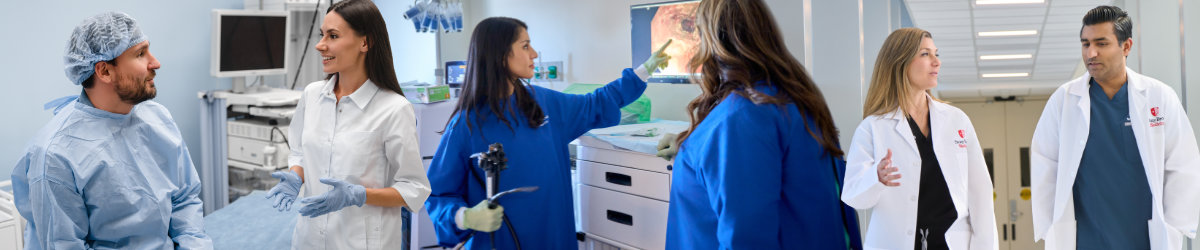
For the diagnosis and treatment of GERD
At Stony Brook Medicine, our teams are comprised of world-class physicians offering the latest technology and state-of-the-art care for patients with GERD.
What is GERD?
Gastroesophageal reflux disease, sometimes referred to as GERD, is a chronic disease that occurs when stomach acid or bile repeatedly flows back into the tube connecting your mouth and stomach, which is your esophagus. If you experience acid reflux or heartburn (burning pain or discomfort in your chest, behind your breastbone, and sometimes in your neck or throat) twice-a-week or more, you may have GERD.
What Are The Symptoms?
Symptoms can vary from person to person, but can include:
- heartburn
- regurgitation
- nausea
- ulcers
- stricture
- asthma
- chronic cough
- voice changes
- recurrent lung infections
- changes in the lining of the esophagus, called Barrett's esophagus
Who Can Diagnose and Treat GERD?
We have specialized medical expertise and technically advanced procedures here at Stony Brook. Our multidisciplinary team includes gastroenterologists, motility specialists, interventional endoscopists and surgeons. We all work together to evaluate, diagnose, and treat complex diseases and disorders of the esophagus and stomach.
What's The Treatment for GERD?
We often treat GERD with lifestyle modifications and medications, but not all patients respond to these treatments. Our physicians may recommend endoscopic procedures and motility testing for further evaluation of symptoms of GERD. These tests help our team decide which type of intervention is most appropriate for the treatment of GERD that are not responding to traditional therapies. An overview of testing and treatment options are described below.
Who Can Treat GERD?
GERD is treated by our Interventional Endoscopy Team, which is made up of highly skilled interventional gastroenterologists. They are experts in a procedure called endoscopy that can be used for diagnosing and treating GERD (and other conditions).
Who Can Treat GERD at an Advanced Stage?
For some patients, GERD symptoms fail to improve with lifestyle modification and medications. While medications can provide relief for most patients, poor response to medications can be seen for a certain percent of individuals. Sometimes, when GERD occurs, the lower esophageal sphincter (located where the esophagus meets the stomach and protects the esophagus) is no longer effective.
In these cases, surgery can be helpful in recreating a lower esophageal barrier. In addition, the presence of a hiatal hernia can predispose patients to GERD. For patients with a hiatal hernia and resistant GERD, surgical repair of the hiatal hernia can provide symptomatic relief, and decrease the need for anti-reflux medications.
Our team of highly skilled surgeons can perform surgery in these situations. Learn more about the surgical treatments for GERD here.
APPOINTMENTS
(631) 638-GERD
(631) 638-4373
Advanced Specialty Care
at Lake Grove
4 Smith Haven Mall
Suite 203A
Lake Grove, NY 11755
GENERAL NUMBER
(631) 444-5220