
The primary responsibility of those engaged in healthcare is to heal and to promote human health, but hospital operations can have large-scale negative effects on the natural environment. It has been established that energy usage, waste, and toxic chemicals have a direct effect on public health. Accordingly, healthcare facilities are taking the lead in correcting and preventing their negative impacts on the environment — while at the same time implementing ways to operate more efficiently. Strong leadership support is necessary for successful sustainability programs. We worked to meet the New York State mandates and signed the HHS Health Sector Climate Pledge. The organization Practice Greenhealth has found that the most successful environmental sustainability programs in healthcare facilities have strong support from their leadership.
Engaged leadership in environmental sustainability programming includes building a team, developing an annual plan, setting measurable goals, and communicating success stories. We built a robust healthcare sustainability program inspired by these initiatives: Less Waste, Safer Chemicals, Greening the OR, Healthy Food, Environmentally Preferable Purchasing, Energy/Water Conservation, Green Building and Engaged Leadership. Each initiative has an assigned leader, a team and a set of reporting metrics and goals. We developed a solid structure for reporting sustainability results, via our Healthcare Sustainability Committee. Reporting occurs on an annual calendar year basis. Strategic goals are reviewed for completion and new goals are developed for the next reporting year.

Recent Highlights:
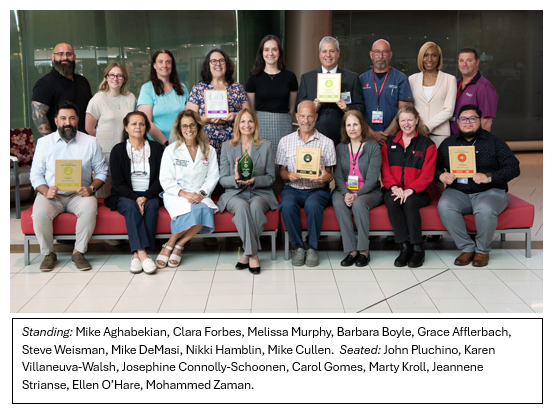
In 2025, Stony Brook University Hospital was recognized by Practice Greenhealth (PGH) as one of the Top 25 Hospitals in their national program – their highest level of recognition. The Top 25 Environmental Excellence Award is Practice Greenhealth’s highest honor for hospitals. These recognized hospitals are leading the industry with innovation in sustainability, demonstrating superior programs, and illustrating how sustainability is a core part of their culture.
PGH praised four of our programs with their Circles of Excellence recognition. This award highlights hospitals that are driving innovation in sustainability performance across different categories. SBUH was recognized in the following categories:
The Chemicals category honors hospitals with sound chemical reduction policies and practices. Winners address toxicity through greener cleaning programs and avoidance of chemicals of concern in purchasing products, services, and equipment.
The Environmentally Preferable Purchasing category celebrates the best in environmentally preferable purchasing programs. Facilities are evaluated on their supporting policies, interactions with suppliers, environmentally preferable contracts, and use of environmental attributes in RFPs and business reviews.
The Energy category celebrates hospitals that are leading the sector in energy efficiency and strategic energy use planning. Leaders generally have energy managers and written programs to reduce energy use over time. They are tracking energy use intensity and ENERGY STAR performance metrics and sharing details on comprehensive project implementation and staff engagement strategies.
The Green Building category is presented to hospitals that have demonstrated LEED and other green building achievements over the past five years. These hospitals emphasize policies that show commitment to or even requirement of LEED-level construction standards for all major new builds or renovations. Their achievements include energy and water efficiency, safer materials, regional sourcing, integration of nature and other mechanisms to create high-performance healing environments.
AAMC’s Accelerating Sustainability and Resilience Initiative
Stony Brook University Hospital is also a member of the Association of American Medical College’s Accelerating Sustainability and Resilience Initiative, which aims to deepen climate action at academic health systems and accelerate solutions to address climate change. This initiative aims to:
- Strengthen and expand commitments and action among AHS senior executives that demonstrably accelerates climate action.
- Share best practices to facilitate more rapid diffusion of innovative, climate-smart, sustainability methods and solutions across health systems that lead to improved clinical quality, better health, and reduced operational costs.
- Implement a multi-step metrics-driven plan for climate action at our own institutions and benchmarking those efforts among peers to collaboratively drive improvements.
- Leverage collaborations with other national organizations to amplify our commitments and action.
- Influence the entire health sector to take action at their own institutions as well as advocate nationally.
Team Leaders:
Carol Gomes, Colette Brown, and Barbara Boyle
Policies:
EC0069 Hospital Recycling and Sustainability
EC0040 Reusable Hospital Surplus Property
LD0105 Clinical Products Request, Standards and Evaluation Program and Process