


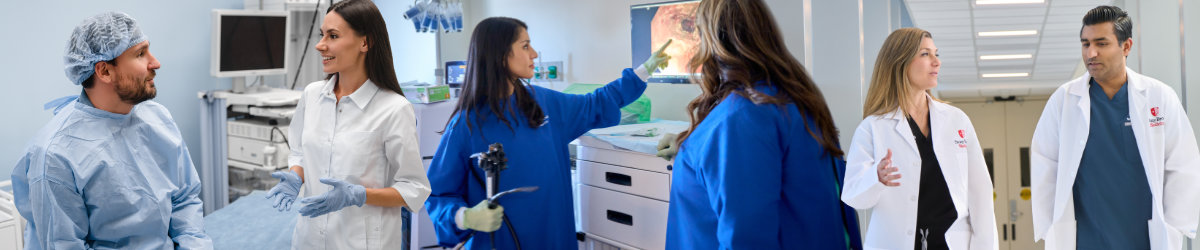
The Gastrointestinal (GI) Motility Center uses a highly sophisticated approach to evaluate, diagnose and provide individualized treatments for complex disorders that affect the movement of the muscles (motility) in the digestive tract and can impair digestion.
These conditions can cause a variety of symptoms such as:
- heartburn
- difficulty swallowing (dysphagia)
- constipation
- nausea
- vomiting
- abdominal pain
- gas
- bloating
- fecal incontinence
- irritable bowel syndrome
- gastroesophageal reflux disease (GERD).
Innovative Care
Because sophisticated technology and advanced training are required to conclusively diagnose these complex conditions, patients are often referred to a comprehensive motility center by their gastroenterologist. Previously, patients had to travel to receive the level of treatment that is now available close to home, at Stony Brook. With the growing prevalence of motility disorders in our region, Stony Brook's GI Motility Center has quickly become the go-to resource to help patients on Long Island regain normal GI motility and improve their quality of life.
A Comprehensive and Progressive, Multidisciplinary Approach
Our approach to motility includes an extended, multidisciplinary team of specialists to ensure that the “whole” patient is treated. Patients are first evaluated and diagnosed by leading motility experts who use state-of-the-art diagnostic tools to measure, record, and analyze every pattern of intestinal contraction from the esophagus to the anorectal region so they can provide the safest, most effective course of treatment for a positive outcome. Depending on individual patient diagnoses, our motility specialists may also call upon experts from all other relevant areas of GI motility to provide treatment as needed. Specialists from speech therapy, nutrition, psychological and psychiatric support, advanced endoscopy and minimally invasive surgery are all part of the extended motility team.
We understand that conditions involving motility can sometimes make patients feel uncomfortable, awkward or embarrassed to talk about their symptoms. Each patient referred to our Center is treated with compassion, patience and understanding.
Diseases Treated
We provide advanced evaluations, diagnoses and treatment of the following gastrointestinal motility and function disorders:
- Barrett’s esophagus is a precancerous condition in the lower esophagus, often due to repeated exposure to stomach acid. It is most often diagnosed in people with chronic gastroesophageal reflux disease (GERD) and is characterized by a change in the color of the lining of the lower esophagus.
- Chronic constipation generally includes infrequent bowel movements (less than three times a week over several months) and may be caused by such conditions as irritable bowel syndrome (IBS) or pelvic floor dysfunction (when the muscles that surround a woman’s rectum do not function normally). Other, more serious conditions, such as colon cancer, an underactive thyroid gland, or neurological diseases such as multiple sclerosis or Parkinson’s disease may be the cause.
- Esophageal motility disorders impact the movement (motility) of the muscles in the esophagus. These disorders can cause difficulty swallowing, regurgitation of food (acid reflux) and spasm type pain.
- Achalasia occurs when the valve-like, circular muscles in the lower esophageal sphincter (LES) are unable to completely relax and the smooth muscle walls of the esophagus are unable to move food down the esophagus to the small intestine.
- Diffuse esophageal spasm occurs when there are uncoordinated contractions of the esophagus and food is not propelled effectively into the small intestine.
- Nutcracker esophagus is a condition that causes difficulty swallowing both solid and liquid foods and derives its name from the level of increased pressure present in the esophagus during testing that is equivalent to the pressure exerted with a mechanical nutcracker.
- Fecal incontinence refers to the loss of regular control of the bowels. It is more common in older adults and often accompanied by involuntary excretion or leaking.
- Gastroesophageal reflux disease (GERD) is commonly known as “acid reflux.” GERD occurs when liquid content of the stomach backs up into the esophagus and irritates the lining there. Chronic GERD symptoms can cause damage to your esophagus and may result in more serious digestive disorders like esophageal cancer, if left untreated.
- Gastroparesis is also called “delayed gastric emptying.” This condition consists of partial paralysis (paresis) of the stomach, which results in food remaining in the stomach for a longer period of time than normal. If left untreated, gastroparesis can lead to malnutrition and GERD.
- Irritable bowel syndrome (IBS) is also known as a spastic colon and often characterized by chronic abdominal pain, discomfort, bloating and changes in bowel habits (diarrhea or constipation).
Clinical Services
We determine and provide the most effective course of treatment to reach the best possible outcome by using gold-standard motility testing techniques and therapies.
Esophagus:
- High-resolution esophageal manometry: An advanced technique using high-tech, 32-sensor accuracy and precision that measures and evaluates the strength and muscle coordination of the esophagus when you swallow. It is used to diagnose achalasia (a condition that causes food to back up in the stomach).
- BRAVO 48-Hour pH testing: A state-of-the-art test that is performed to learn definitively, whether surgery for an acid reflux condition is warranted or not.
- 24 Hour pH testing: Used to measure and record how often stomach acid flows into the lower esophagus during a 24-hour period.
- 24 Hour pH impedance testing: Definitively diagnoses GERD that occurs on a chronic basis despite treatment by standard methods.
- Radiofrequency ablation of Barrett’s esophagus: A cutting-edge endoscopic procedure requiring advanced training, it burns away precancerous lesions associated with Barrett’s esophagus. Within Suffolk County, it is performed only at Stony Brook.
- Complex stricture dilation: Performed, using stents, to widen the esophagus to ease dysphagia (difficulty swallowing) and facilitate the completion of an endoscopic procedure to remove a benign or malignant obstruction in the esophagus.
Colon:
- High-resolution anorectal manometry: A technique that assesses the function of the anus and the rectum. This technique is utilized to evaluate fecal incontInence and diagnose pelvic floor dyssynergia (a problem with coordinating the rectal and anal muscles). In some cases, this technique is performed in combination with pelvic floor retraining/biofeedback.
- Pelvic floor retraining/biofeedback: Electrical stimulation therapy used to re-train patients to coordinate their rectal muscles to improve defecation and fecal incontinence.
Breath Tests:
- Bacterial overgrowth: Administered to detect the presence of excessive bacterial growth in the small intestine that can be caused by low stomach acid due to slow movement of food into the intestine, or other conditions such as diabetes or Crohn’s disease.
- Lactose intolerance: Used to diagnose a person’s inability to digest lactose, the sugar found in milk. It is also used to determine if abnormal bacteria is present in the colon.
- Helicobacter pylori or H. pylori: Detects the presence of bacteria in the stomach or duodenum (first part of the small intestine) that can cause gastritis or stomach or intestinal ulcers.
APPOINTMENTS
(631) 444-1759
Motility Center
MISSION & VISION
Our Mission
The Gastrointestinal (GI) Motility Center opened in May 2010 as the first comprehensive center of its kind in Suffolk County. Recent studies show that about 20 percent of all Americans are affected by disorders of gastrointestinal motility. Because sophisticated technology and advanced training are required to conclusively diagnose these complex conditions, patients are often referred to a comprehensive motility center by their gastroenterologist.
Our Vision
With the growing prevalence of motility disorders in our region, Stony Brook's GI Motility Center continues to expand and be the go-to resource that helps patients on Long Island regain normal GI motility and improve their quality of life.