


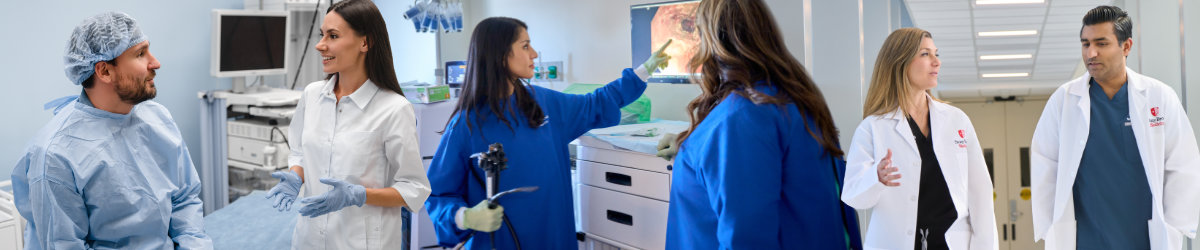
The Interventional Endoscopy Center at Stony Brook Medicine was established in 2008 to evaluate, diagnose and treat complex diseases and cancers of the gastrointestinal (GI) tract, which require specialized medical expertise and technically advanced procedures previously unavailable locally. Since then, it has developed into a premier center comprised of world-class physicians offering the latest technology and state-of-the-art care.
Innovative Care Unique to Suffolk County and Beyond
Endoscopy refers to the procedure of inserting a medical device into the body’s natural orifices (nose, mouth and rectum) to enable a physician to examine a person’s organs and cavities. The device consists of a thin, flexible tube with an attached light source and a small video camera.
With remarkable advances in technology in recent years, endoscopy has become an integral part of the diagnosis and treatment of various GI conditions. A number of minimally invasive endoscopic treatments are now available for various GI diseases and tumors for which traditional surgery used to be the only option. Because sophisticated technology and advanced training are now available to conclusively diagnose and treat many of these complex GI conditions, patients are often referred to an advanced endoscopy center by their gastroenterologist. Our team of highly skilled interventional gastroenterologists offer a complete array of diagnostic and therapeutic options for the entire spectrum of GI diseases.
A Comprehensive, Multidisciplinary Approach
The Interventional Endoscopy Center offers our patients various minimally invasive treatment options for many complex disorders including diseases of the bile duct and pancreas, pre-malignant and malignant tumors of the GI tract and diseases of abnormal GI motility. A dedicated staff is committed to ensuring a seamless experience to our patients with timely communication with them and their referring physicians. Our highly skilled, highly trained Interventional Endoscopy team collaborates with other key specialists, as needed, such as expert surgeons, interventional radiologists, medical oncologists, radiologists, pathologists and radiation oncologists to deliver thoughtful, individualized, state-of-the-art care to achieve the best possible results.
Diseases Treated
We provide advanced diagnostic evaluations and therapeutic options for the following diseases and disorders:
- Achalasia
- Barrett’s esophagus is a precancerous condition in the lower esophagus, often due to repeated exposure to stomach acid. It is most often diagnosed in people with chronic gastroesophageal reflux disease (GERD) and is characterized by a change in the color of lining of the lower esophagus.
- Benign strictures of the gastrointestinal tract
- Benign tumors of the gastrointestinal tract
- Large polyps of the esophagus, stomach, small intestine and colon
- Gastrointestinal stromal tumors (GIST)
- Leiomyoma
- Carcinoid tumors
- Diseases of the bile duct
- Ampullary tumors
- Benign and malignant strictures of the bile duct
- Choledocholithiasis
- Diseases of the pancreas
- Acute and chronic pancreatitis
- Autoimmune pancreatitis
- Benign and malignant strictures of the pancreatic duct
- Cystic neoplasms of the pancreas
- Pancreatic duct stones
- Gastroesophageal reflux disease (GERD)
- Gastroparesis
- Malignancies of the GI tract including cancer of the esophagus, stomach, pancreas, liver, bile ducts and colon
- Obesity
- Obscure bleeding of the GI tract
- Zenker Diverticulum
Clinical Services
We determine and provide the most effective course of treatment to reach the best possible outcome by using gold-standard advanced endoscopy techniques and technologies.
- Endoscopic mucosal resection (EMR) – A procedure to remove a small, polyp-like growth using a small wire loop that fits on the end of an endoscope.
- Endoluminal stent placement – A procedure to insert a stent (a thin expandable tube) to keep the esophagus open.
- Endoscopic ultrasound (EUS) – A procedure that allows for the detailed evaluation of pancreatic and biliary abnormalities. EUS-guided treatments we perform include:
- Celiac nerve block — The injection of a local anesthetic into and around the celiac nerves to provide relief for disabling pain associated with chronic pancreatitis (swelling or inflammation of the pancreas).
- Drainage of abscesses — A novel approach to treating and draining abscesses in the gastrointestinal tract without the use of surgery.
- Evaluation of pancreatic cysts — A procedure used to examine collections of pancreatic duct fluid (cysts) to diagnose chronic or acute pancreatitis.
- Evaluation of subepithelial lesions — Examination of any mass or bulge that is found within a layer of the gastrointestinal tract wall or outside of the wall during an endoscopy
- Fine needle aspiration (FNA) — A diagnostic procedure used to investigate lumps or masses using a thin, hollow needle.
- Placement of fiducial markers for XRT — A fine needle is inserted into a tumor to implant a marker (fiducial) as a reference point to target for future radiation therapy (XRT).
- Pseudocyst drainage — An alternative to surgery, this advanced procedure drains fluid from pancreatic cysts using multiple drains through one puncture site.
- Staging of gastrointestinal (GI) and lung malignancies — Use of EUS-guided staging in the GI tract is considered the gold standard in grouping (staging) GI-related cancers based on the size of the tumor and extent of its progression in other parts of the body (metastasis).
- Electrohydraulic lithotripsy (EHL) — A procedure that use an electric current from a miniature endoscope, which breaks up bile duct stones and urinary tract stones that are too large to be extracted whole, so they can pass out of the body through urine.
- ERCP with Spyglass™ Cholangioscopy and Pancreatoscopy — ERCP stands for endoscopic retrograde cholangiopancreatography, a test that combines the use of endoscopy and fluoroscopy (dye injected into the bile or pancreatic duct and shows up on an x-ray) to definitively diagnose and treat abnormalities in the pancreas. ERCP with Spyglass technology is a procedure that uses state-of-the-art equipment, which enables the endoscopist to view deeper into the bile duct and pancreas to definitively diagnose a malignant tumor or determine the need for laser therapy. In Suffolk County, Spyglass technology is available only at Stony Brook.
- Gastric per-oral endoscopic myotomy (G-POEM) — a newly developed minimally invasive treatment that offers patients attractive benefits, compared with other surgical therapies. It involves use of an endoscope (thin flexible tube). It is an alternative to surgical pyloroplasty.
- Management of obscure bleeding — Diagnostic endoscopic evaluations including capsule endoscopy, and endoscopic therapies used to manage uncommon, chronic, unexplained bleeding, which is most common in the elderly.
- Mechanical lithotripsy — Using a catheter, this technique, which is often used in combination with EHL and ERCP, removes bile duct stones from the bile duct.
- Pancreatic endotherapy — Therapy that is delivered endoscopically for pancreatic diseases such as chronic pancreatitis (swelling or inflammation of the pancreas that leads to scarring and loss of the pancreas’ function).
- Peroral Endoscopic Myotomy (POEM) — a minimally invasive endoscopic procedure that can permanently cure achalasia.
- Radiofrequency ablation (RFA) of Barrett’s esophagus — This leading-edge procedure burns away precancerous lesions associated with Barrett’s esophagus.
- Transoral Incisionless Fundoplication (TIF) — This innovative, outpatient procedure addresses the root cause of Gastroesophageal Reflex Disease (GERD) and requires no incision.
- Wireless capsule endoscopy — Also known as a “pill cam,” this non-invasive test uses a pill-size capsule that contains a camera to record images of the digestive tract and diagnoses obscure (unexplained and persistent) gastrointestinal bleeding.