

 D
D
Ticks in Our Midst
Introduction
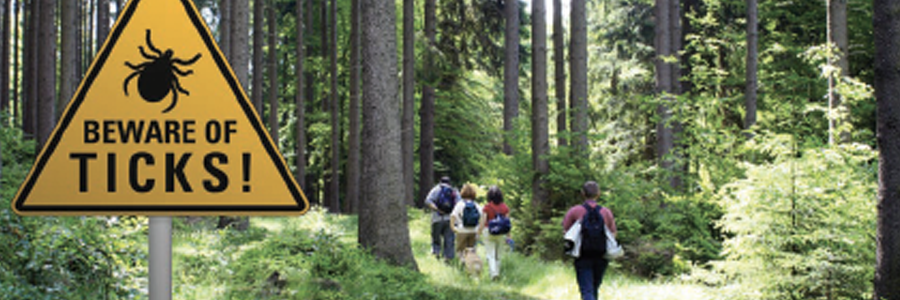
In Suffolk County, there are four tick species that are of public health importance and that are responsible for the transmission of a variety of tick-borne pathogens. Three of these species are the blacklegged (deer) tick (Ixodes scapularis), the lone star tick (Amblyomma americanum), and the American dog tick (Dermacentor variabilis). Each species is capable of transmitting pathogens that cause human disease.
Life Cycle
A tick life cycle has four stages: the egg, the larva (plural larvae), the nymph, and the adult (male and female). The larval, nymphal and adult stages actively quest (search) for hosts for blood feeding or reproduction. For all tick species, the larva and nymph require a blood meal for development to the next life-cycle stage. The adult female requires a blood meal for egg production. In Suffolk County, tick life cycles typically take two years and the type of host will vary with the tick species and stage. All stages of the blacklegged (deer) and lone star ticks will attach to humans, while only adult American dog ticks will bite humans. Ticks are most active during the spring and summer months, and adult blacklegged (deer) ticks are active during the winter months when the temperature is above 40oF. Therefore, the risk of tick bites is continuous throughout the year in Suffolk County.
Ticks acquire human pathogens (i.e. bacteria, viruses or protozoa) from an infected host (i.e. reservoir host) during the blood meal. These pathogens are in the host’s blood and enter the tick gut during feeding. If the particular tick species is a competent vector for the pathogen ingested, the tick will be able to pass it to the next host in the subsequent blood meal.
Name of Practice / Center
Address, Suite 000
Town, NY 11111
Blacklegged Tick
(Ixodes scapularis). Other name: deer tick
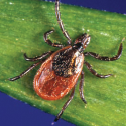 The blacklegged (deer) tick can transmit a variety of pathogens including Borrelia burgdorferi (Lyme disease), Anaplasma phagocytophilum (anaplasmosis), Borrelia miyamotoi (Borrelia miyamotoi disease), Babesia microti (babesiosis), and Powassan virus disease. The greatest risk of being bitten exists in the spring and summer but adult ticks will be actively searching for a blood meal in the fall and winter when the temperature is above 40oF. All stages of the blacklegged (deer) tick bite humans.
Lone Star Tick
(Amblyomma americanum)
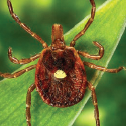 This tick species is more common in the South with an expanding northern range including Suffolk County. The lone star tick transmits various pathogens including Ehrlichia chaffeensis and E. ewingii (human ehrlichiosis), Francisella tularensis (tularemia), Heartland virus, Bourbon virus, and southern tick-associated rash illness (STARI). This tick species is active from early spring through late fall. It is a very aggressive tick and all stages bite humans. Lone star tick saliva can be irritating, with redness and discomfort at a bite site, which does not necessarily indicate an infection. Also, an allergic reaction associated with the consumption of red mammalian meat (i.e. alpha-gal meat allergy) has been reported in humans bitten by lone star ticks.
American Dog Tick
(Dermacentor variabilis) Other name: wood tick
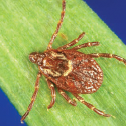 The American dog tick can transmit Francisella tularensis (tularemia) and Rickettsia rickettsii (Rocky Mountain spotted fever). Adult male and female ticks will bite humans. Larval and nymphal stages do not bite humans but feed primarily on rodents. The greatest risk of being bitten occurs during spring and summer.
Asian Longhorned Tick
(Haemaphysalis longicornis). Other names: cattle tick (New Zealand); bush tick (Australia)
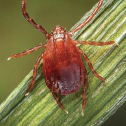 This tick is indigenous to eastern Asia and is now an invasive species to the United States. The first tick specimens were collected in Suffolk County in 2018. These ticks are found in a variety of habitats, including meadows, and grassy areas near forests. They will bite humans, pets, birds, livestock and wildlife. Fortunately this tick appears to be less attracted to human skin than other native tick species. Invasive Asian longhorned ticks can reproduce without mating. This is called parthenogenesis, and means that female ticks do not need males to fertilize their eggs. In the US, it is still unknown the role this species has in the transmission of pathogens to animals or humans. Research is ongoing.
Groundhog Tick
(Ixodes cookei)
Other name: woodchuck tick
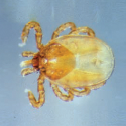 The groundhog tick can transmit Powassan virus disease. All life stages feed on a variety of mammals including groundhogs (i.e. woodchucks), skunks, squirrels, raccoons, foxes, domestic animals and humans.
Larval Lone Star Ticks Versus “Chiggers”
During the mid to late summer, Suffolk County residents often complain about being bitten by “chiggers” which results in numerous itchy red bites. It is believed that these bites are the result of larval lone star ticks and not “chiggers.” Although both “chiggers” and larval lone star ticks are about the same size and have six legs, there are some differences. A comparison of these two organisms shows that “chiggers” are larval trombicular harvest mites (Eutrombicula alfreddugesi) that typically become active in spring, after a rain event, since “chiggers” require a moist environment. However, “chiggers” have never been identified on Long Island.
Larval lone star ticks (Amblyomma americanum) typically are active from approximately July through October and are less susceptible to desiccation (drying out) so a moist environment is not needed. The evidence that the complaints of “chigger bites” are caused by larval lone star ticks, and not “chigger” mites, is mostly circumstantial, but very compelling. All specimens submitted by Suffolk County residents and analyzed at our entomology lab have been identified as larval lone star ticks, not “chiggers.”
(See photo in Chapter 16 Alpha-gal Allergy).
 Scott R. Campbell, PhD
Scott R. Campbell, PhD
Arthropod-Borne Disease Laboratory Chief Suffolk County Department of Health Service
Tick Borne Disease Reference Handbook
 |